Author: Ir. Dr. Justin LAI Woon Fatt | 30 December, 2025
INTRODUCTION
A fire detection and alarm system comprises multiple devices that collaborate to detect and alert individuals by visual and auditory signals in the presence of smoke, fire, carbon monoxide, or other problems. Fire alarms can be activated automatically by fire detection system such as smoke, heat and flame detectors, or manually through manual call points or pull stations. Devices for manual fire alarm activation are installed in locations that are easily accessible (near the exits), clearly identified, and operable. Early identification not only aids in the prevention of fire spread but also allows firefighting officials to respond more quickly. This prompt intervention minimises potential damage to the structure and its contents, reducing the financial and emotional toll on property owners.
THE SIGNIFICANCE OF FIRE DETECTION AND ALARM SYSTEMS
Malaysia has witnessed disastrous fires resulting in loss of life and property damage. Fire detection and alarm systems are now a critical component of the country’s safety infrastructure to mitigate these hazards. These systems are designed to detect fires early, triggering alerts for occupants and authorities to allow for timely evacuation and response. They serve a variety of purposes, including:
- Early Detection: Sensors identify heat, smoke, or flames at the incipient stage of a fire.
- Notification: The system activates sirens, strobe lights, or voice announcements to alert occupants to the hazard.
- Automatic Suppression Activation: Depending on system type, fire suppression may be activated either independently by heat (e.g. sprinklers) or triggered through the fire alarm system (e.g. gas suppression or pre-action systems).
- Communication with Authorities: Modern systems link directly to fire departments or monitoring centres to facilitate rapid emergency response.
CODES AND REGULATIONS
Several regulations and codes must be followed to ensure the effectiveness and dependability of fire alarm systems in Malaysia. The Uniform Building By-Laws (UBBL) in Malaysia include regulations for fire safety in buildings. They specify the standards for the installation and maintenance of fire alarm systems, including detectors, alarms, and communication devices. The criteria for automatic fire detection and alarm systems, including provisions for fire alarms, fire command centres, and voice communication systems, are outlined in Law 237, 238 and 239 of the Uniform Building By-Laws (UBBL) 1984 [1].
By-Law 237: Fire Alarms
Fire alarms must be provided in accordance with the Tenth Schedule to these By-laws.
By-Law 238: Fire Command Centre
(1) A fire command centre shall be provided in accordance with the Tenth Schedule, located on the fire appliances access level and shall contain a panel to monitor a public address system, fireman intercom, sprinkler system, water flow detector, fire detection and alarm system and with an automatic fire monitoring system connected to the appropriate fire station by-passing the switchboard or other relevant automatic systems.
(2) A fire command centre shall be separated from other parts of the same building by a compartment wall or compartment floor which is having at least two hours fire resistance period, is readily accessible, preferably directly from the open air, and unless inapplicable, a route to the fire command centre shall be protected.
By-Law 239: Voice Communication System
There shall be two separate approved continuously electrically supervised voice communication systems including a fireman intercom system and a public address system in the following areas:
(a) The fireman intercom shall be provided in every firefighting access lobby or adjacent to a fire fighting staircase and shall also be provided in a refuge area, lift motor room, fire pump room, generator room and fire command centre in accordance with the Tenth Schedule; and
(b) The public address system shall be provided in accordance with the Tenth Schedule.
MAIN TYPES OF FIRE DETECTION AND ALARM SYSTEMS
- Conventional Systems
Conventional systems operate by using physical cabling to connect multiple detectors and manual call points to a central control panel. These systems are commonly applied in small commercial premises such as shops, restaurants, and offices, where the building is divided into several detection zones. Each zone is typically equipped with alarm devices such as bells or electronic sounders. When a detector or manual call point is activated, the control panel indicates the affected zone through visual indicators or text display, allowing personnel to investigate and identify the source of the alarm. - Addressable Systems
Addressable systems provide real-time information and status updates for individual detectors and devices. Each device is assigned a unique address, typically configured through software or DIP switches, allowing the control panel to identify the exact location of an activated or faulty device. The detection circuit is wired in a loop configuration, enabling multiple devices to be connected on a single circuit. - Intelligent Systems
Intelligent systems incorporate microprocessors within each detector, allowing the devices to analyse environmental conditions and communicate detailed status information to the control panel. These systems are capable of reporting faults, fire conditions, and maintenance requirements such as detector contamination or the need for cleaning. Compared to conventional and standard addressable systems, intelligent systems are more advanced and offer enhanced diagnostic and control features. - Wireless Systems
Wireless systems are a practical alternative to conventional wired fire alarm systems. In a wireless system, detectors and devices communicate with the control panel through secure, licence-free radio signals. These systems eliminate the need for physical cabling while still providing reliable fire detection and monitoring functions.
- Conventional Systems
FIRE ALARM PANELS
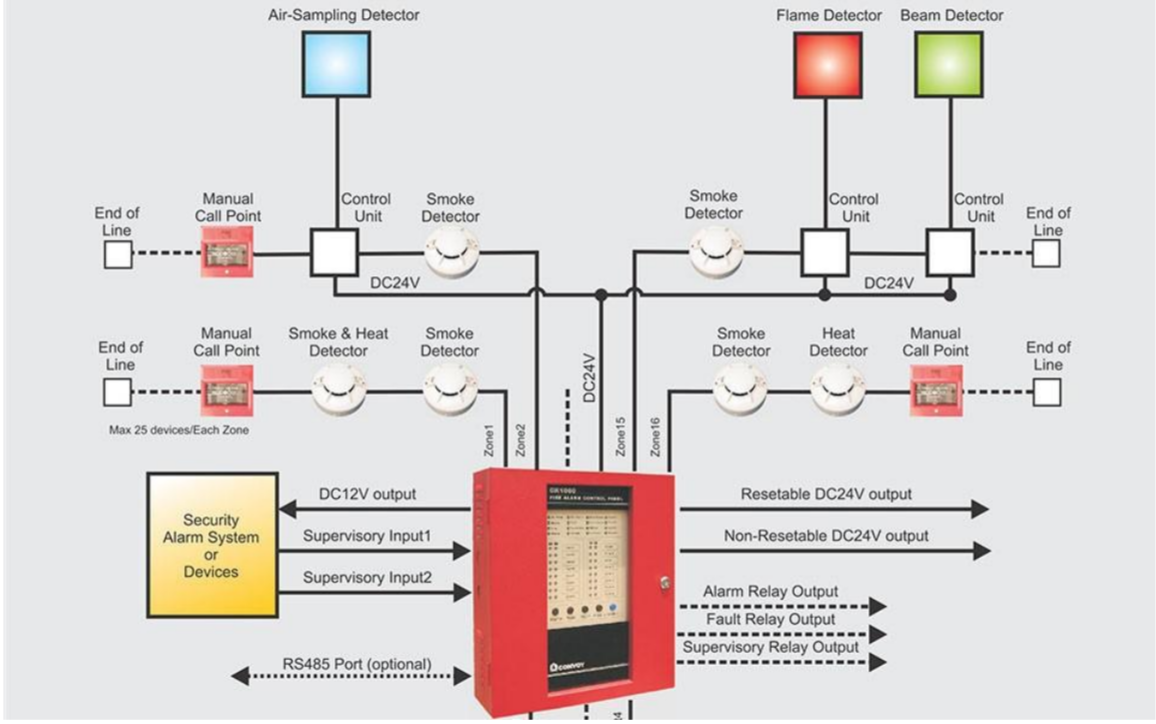
Fire detection and alarm systems are controlled by fire alarm panels, sometimes referred to as fire alarm control panels (FACP) or fire alarm annunciator panels. Their primary function is to receive and process data from various detection devices, and then initiate the appropriate response when a fire or smoke is detected.
The main fire alarm panel must be installed in a readily accessible area, such as the Fire Command Centre (FCC), security room, guardhouse, main entrance, lobby, or other locations acceptable to the Fire and Rescue Department of Malaysia (FRDM). Its components include:
- Alarm, fault and isolation indication for each zone;
- Indicator lights to monitor status of power supply and fire safety, such as fire pumps, smoke control equipment, carbon dioxide (CO2) systems, fire tank water levels and other equipment;
- Mimic panel to identify location of each zone; and
- Battery with charger to provide power supply for the whole system.
MAINTENANCE FOR FIRE DETECTION AND ALARM SYSTEMS
The maintenance of the fire alarm system should be carried out on a regular schedule to ensure it functions effectively during an emergency, thus protecting the building and its occupants in a fire. Visual inspections are carried out once a month to assess the power status, indication lights, and control panel condition. The functioning of detectors, alarm sounders, manual call points (MCPs), and communication links are recommended to be tested frequently to guarantee appropriate reaction and signal transmission. During the same period, battery and power supply inspections are performed to measure voltage, test the charger, and replace any faulty batteries to ensure continuous power delivery. In addition, fire alarm system maintenance can prevent unnecessary false alarms that hinder firefighters from responding to other more important emergencies.
CONCLUSION
In conclusion, fire alarm systems are vital for protecting lives and property through early detection, rapid reporting, and coordinated emergency response. The Uniform Building By-Laws (UBBL) 1984, particularly By-Laws 237, 238, and 239 highlight their importance in Malaysia by mandating fire alarms, command centres, and voice communication systems where applicable. With various options available including conventional, addressable, intelligent, and wireless system, building owners can select solutions that fit their specific needs while ensuring legal compliance and permitted by the FRD. Ultimately, installing a reliable fire alarm system fulfills statutory obligations and significantly reduces the risk of injury and property loss, reflecting a commitment to building safety and public protection.
Ir. Dr. Justin LAI Woon Fatt
CEO/ Founder
IPM Group