Author: Ir. Dr. Justin LAI Woon Fatt | 19 April, 2026
INTRODUCTION
Dry risers are vertical firefighting mains installed in buildings to facilitate rapid vertical water delivery by the Fire and Rescue Department of Malaysia (BOMBA) firefighters during fire emergencies. A typical dry riser system consists of a breeching inlet, landing valves, riser pipes, hose cradles, and air-release valves. Proper installation of dry risers is essential to ensure safety, regulatory compliance, and effective fire response.
REQUIREMENTS
One of the primary factors influencing the installation of dry risers is building height. By-Law 230 in the Uniform Building By-Law 1984 (Amendment 2021) specifies that dry risers are mandatory if the building height is between 18 metres and 30 metres from the fire appliance access level to the top-most accessible level (mid-rise buildings), designed in compliance with MS 1489 [1]. This requirement is based on the operational limitation of manual hose deployment to upper floors during fire incidents. Unlike wet risers, which are permanently filled with water, dry risers rely on the fire engine to pump water into the system through a ground-level breeching inlet.

DESIGN STANDARDS
i) Landing Valve
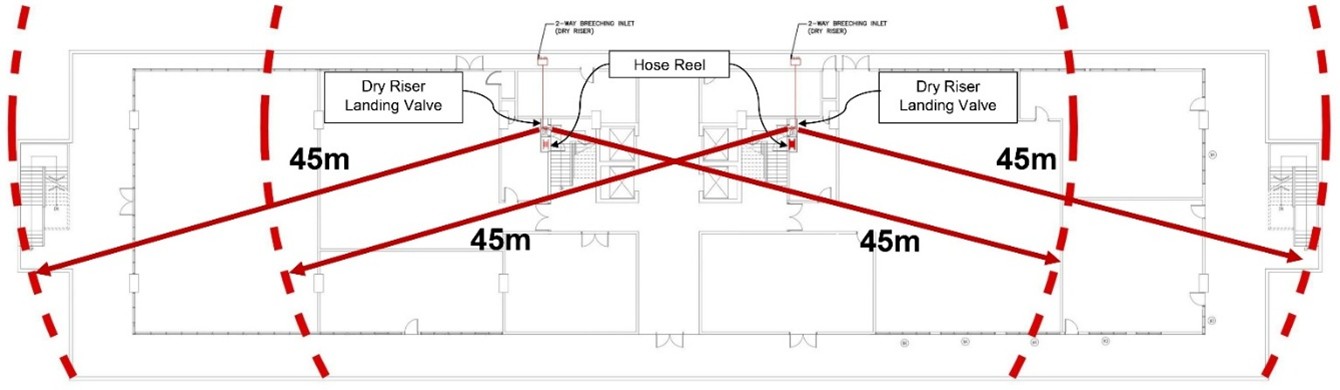
Each landing valve shall be located such that all areas are within a 45 m radius, and the hose nozzle can reach within 15 m of any point, with consideration of obstructions, or as per relevant MS / BOMBA requirement and approval [1]. Landing valves must be installed on each floor, including the ground floor, to allow connection of fire hoses and nozzles. Landing valves shall be located within a protected staircase, ventilated lobby, or other positions as approved by the Director General of BOMBA. Moreover, they should be located at least 750 mm above floor level, enabling firefighters to connect hoses without difficulty. To protect against vandalism and extreme weather, valves should be installed in a cabinet or box as specified in MS 1210: Part 4. Additional requirements include:
• Fire hose not less than 38 mm in diameter and 30 m in length, complete with 65 mm diameter quick coupling and nozzle, shall be provided in a hose cradle beside each landing valve [1].
• A landing valve should be provided at roof level for testing purposes, if practicable.
ii) Breeching Inlet
The breeching inlet is located at the fire appliance access level to allow water to be pumped into the system. It should be designed and installed in accordance with MS 1210: Part 3. The enclosure for the breeching inlet must comply with MS 1210: Part 5 and be clearly labelled “Dry Riser Inlet” [1]. A drainage point should be installed at the base of the riser to remove water after use.
• For a 100 mm diameter dry riser, a two-way breeching inlet is required.
• For a 150 mm diameter dry riser, a four-way breeching inlet must be provided.
Breeching inlets should be positioned no more than 18 metres from the fire appliance access road and within 30 metres of the nearest external hydrant outlet to ensure efficient water transfer from the fire appliance into the dry riser system during firefighting operations, subject to BOMBA’s approval.
iii) Pipe
A 100 mm diameter pipe is acceptable unless the highest outlet is located more than 22.875 metres above the breeching inlet, in which case a 150mm diameter pipe is necessary [1]. The riser pipe should be galvanised iron in accordance with BS 1387 (Heavy Gauge) or Class C, and tested to withstand 21 bars of pressure. The riser pipe must also be electrically earthed or connected to the building’s grounding system to ensure equipotential bonding. Horizontal pipework feeding the riser shall be installed with a gradient to ensure complete drainage after use. An air release valve is required at the top of the riser to vent any trapped air.
TESTING AND MAINTENANCE
Newly constructed dry risers shall undergo pressure testing prior to commissioning. Before being put into service, pipes shall first undergo flushing to remove debris present in the system, followed by a hydraulic test at 14 bars for 2 hours, or as per relevant MS / BOMBA requirement and approval [1]. The pressure is measured at the breeching inlet, and any leakage at joints or landing valve connections shall be identified and rectified. Upon satisfactory testing, monthly visual inspections of all components, including breeching inlets, landing valves, hoses, pipes, drain valves and cabinets are required to ensure the dry riser remains fully operational.
CONCLUSION
Dry risers are an essential fire safety feature, particularly in mid- to high-rise buildings where manual hose deployment is impractical. The decision to install dry risers depends primarily on building height, with additional considerations to ensure easy and rapid accessibility by firefighting personnel. Adhering to local standards and ensuring proper installation and maintenance can significantly enhance building safety and firefighting efficiency during emergencies. Proper coordination between architectural (passive fire protection) and M&E (active fire protection) in building design is essential to ensure system accessibility, reliability, and compliance during emergency operations
Ir. Dr. Justin LAI Woon Fatt
CEO/ Founder
IPM Group